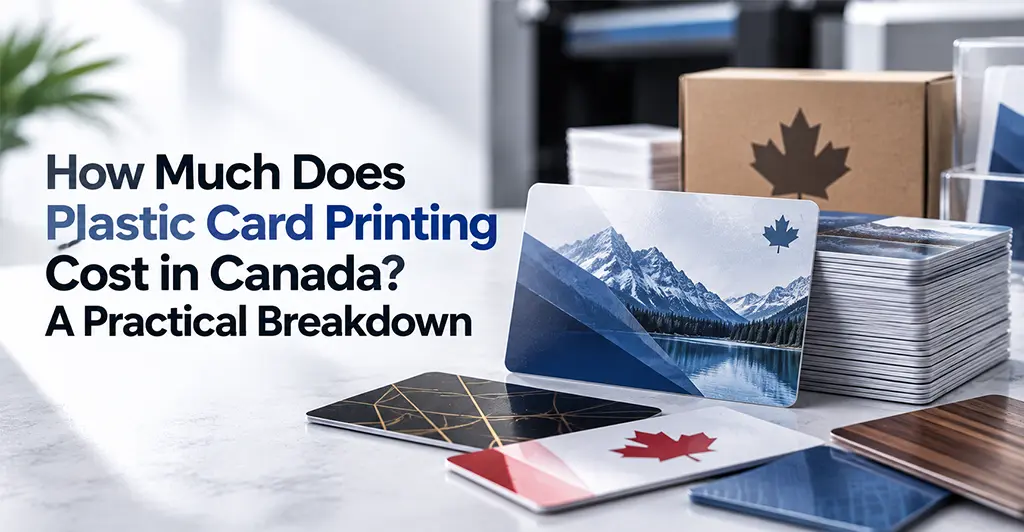
In Canada, plastic card printing generally runs between $0.20 and $2.50 per card. That is a wide band, and it is wide for a reason. A run of 5,000 basic PVC loyalty cards is priced very differently from 100 embossed membership cards with a magnetic stripe and rush turnaround. This piece walks through what actually drives the number on your quote.
What a Standard Order Actually Costs
For a standard CR80 card (the credit-card size, 30 mil thick, printed full colour on both sides), Canadian pricing tends to land in these bands:
| Quantity | Approx. per-card cost (CAD) |
| 100 – 250 | $1.75 – $2.50 |
| 500 | $0.75 – $1.20 |
| 1,000 | $0.45 – $0.75 |
| 2,500 | $0.35 – $0.55 |
| 5,000+ | $0.20 – $0.35 |
These are ballpark figures pulled from published rates at Canadian and North American printers, including Clubcard Vancouver and 4OVER4. The pattern is consistent across the industry: every printer prices in bands, and per-card cost drops sharply as the run gets bigger.
Setup fees, artwork charges, shipping, and tax are usually extra. A basic setup fee typically sits between $25 and $75 depending on the printer.
Six Factors That Move the Price
1. Quantity: the single biggest lever. Plastic card printing is an offset process, which means the press setup is the same whether you are printing 250 cards or 25,000. That fixed cost gets spread across the run. Doubling the quantity rarely doubles the invoice; it often adds 30 to 50 percent while cutting your per-card cost in half.
2. Material and thickness. Standard PVC at 30 mil (0.76 mm) is the industry default and the most cost-effective. Move to thicker 40 mil stock, or specialty materials like clear or frosted PVC, and the material cost climbs. Composite PET-G cards used for retransfer printing sit at a further premium.
3. Print coverage. Full colour on one side is cheaper than full colour on both sides. Black-only on the reverse is a common way to save without looking cheap.
4. Add-ons. This is where quotes vary the most. Each of these adds real per-card cost:
- Magnetic stripe (LoCo or HiCo): roughly $0.10 – $0.25 per card
- Barcode or sequential numbering: $0.05 – $0.15 per card
- Signature panel: $0.05 – $0.10 per card
- Embossing with tipping: $0.15 – $0.35 per card
- Gold or silver foil stamping: $0.20 – $0.50 per card
- Scratch-off panel: $0.10 – $0.20 per card
- Hole punch or lanyard slot: about $0.05 per card
5. Chip technology. A blank PVC card is one thing; a smart card is another. Contact chips, contactless RFID, MIFARE Classic 1K, and proximity access cards each carry a chip cost that dwarfs the printing itself. A basic RFID card starts around $1.50 per unit at reasonable volume, and jumps significantly for higher-security chips.
6. Turnaround time. Standard production in Canada usually runs 8 to 15 business days. Rush service, whether that is a 1, 3, or 5 day turnaround, typically adds 20 to 40 percent to the base cost. If you can plan two weeks out, you save real money.
Where to Save, Where Not To
If you are pricing PVC card printing for the first time, three quick rules of thumb:
- Order in larger runs when you can. The gap between 500 and 1,000 cards is often only 30 to 40 percent more, for double the cards.
- Skip the finish upgrades no one will notice. Foil edges and embossing look premium, but if the card is for staff IDs handed out at a warehouse, spend that budget on durability instead: thicker stock or a matte laminate.
- Do not cut corners on chip cards. A cheap RFID chip that fails at the door reader is a false economy. Ask for the specific chip standard (MIFARE, HID Prox, EM4100) rather than just “RFID.”
Getting a Real Quote
Any online estimate is a starting point. Your actual price depends on the exact specs: dimensions, thickness, print sides, add-ons, quantity, delivery city, and turnaround. The fastest way to get a real number is to send the printer your artwork (or your rough specs) and ask for a written quote with every fee itemised. That is usually a same-day answer. At Perfect Plastic Cards, the quote is free and includes the setup, print, and shipping breakdown so nothing surprises you when the invoice lands.